
Vocab test
- Este lugar – This place
- La ciudad – The city
- Este país – This country
- La gente – The people
- Una persona – A person
- Conocer – To meet/ To know/ To get to know
- Amar – To love
- Llamar – To call
- Ver – To see
- ¿Por qué no? – Why not?
Verb of the day
Conjugate the verb CONOCER (To know/ To meet) in the present tense.
| Yo | Nosotros |
| Tú | Vosotros |
| Él/ Ella/ Usted | Ellos/ Ellas/ Ustedes |
Questions to answer
1. ¿Conoces a mucha gente aquí?
2. ¿Amas a Diego?
3. ¿Qué países quieres visitar?
4. ¿Por qué nunca visitas a John?
5. ¿Cuándo llamas a tu hermano?
6. ¿Tienes que ayudar a tus padres?
7. ¿Quieres jugar con algunos amigos?
8. ¿Conoces algún país de África?
A simple dialogue
Use the Spanish phrases to translate the English dialogue. Write it out and perform it.
- Do you love Breno?
- He is teaching me Spanish.
- I think he loves Amanda.
- Amanda and Breno know Canada very well.
- She calls him every day.
- He never calls her, but he visits my town every week, and we go to museums and parks together.
- Amanda helps him with his dogs.
- Amanda really understands dogs.
- Do you want to ask Amanda about her relationship with Breno?
- I don’t want to visit Amanda … I don’t really know her.
- Who do you want to visit?
- I want to see Breno. I want to watch a movie with him.
Use these phrases to translate the dialogue.
¿A quién quieres visitar?
¿Amas a Breno?
¿Quieres preguntarle a Amanda sobre su relación con Breno?
Amanda lo ayuda con sus perros.
Amanda de verdad entiende a los perros.
Amanda y Breno conocen muy bien Canadá.
Creo que él ama a Amanda.
Él me enseña español.
Él nunca la llama, pero visita mi ciudad todas las semanas y vamos juntos a museos y parques.
Ella lo llama todos los días.
No quiero visitar a Amanda… Realmente no la conozco.
Quiero ver a Breno. Quiero ver una película con él.
Choose from a range of voices to read your dialogue here.
Grammar notes
* Read this information, then use it to quiz a friend.
THE PERSONAL A
Use the personal “a” when the direct object of the verb is a person (or a pet treated like a person). The personal “a” is not used with inanimate objects.
Conocer (to know, to meet, when referring to people) is a common verb that requires the personal “a” when the direct object is a person.
- ¿Tú conoces a mi amigo Juan? = Do you know my friend Juan?
- ¿Tú conoces esta canción? = Do you know this song?
- Conozco a Juan = I know Juan
- Conozco esa ciudad = I know that city
- Ella conoce a muchos artistas = She knows many artists.
- Ella conoce bien el arte moderno = She knows modern art well
- Ellos conocen el problema = They know the problem
- Nosotros conocemos a María y su familia = We know María and her family
- Nosotros conocemos la historia de España = We know the history of Spain
Conocer means to know or to meet when referring to people. It’s often used to express familiarity or acquaintance, particularly with people, places, or concepts.
Conocer is often confused with saber (to know). Conocer is used for familiarity with people and places, while saber is used for knowledge of facts or skills.
OTHER EXAMPLES
Several other verbs also require the personal “a” when referring to people.
Amar = To love
- Yo amo a mi familia = I love my family
Visitar = To visit
- Ellos visitan a su abuela = They visit their grandmother
Enseñar = To teach
- El profesor enseña a los estudiantes = The teacher teaches the students
Llamar = To call
- Ella llama a su amigo = She calls her friend
Journal prompts
Write short sentences. Keep them as simple as you can.
Use a translation tool to put them into Spanish.
Write them out, then check them with your teacher. Present them to a friend, teaching your friend any new Spanish, and making sure they learn it!
| What topic do you know a lot about? Who are three people you know well? What do you want to teach other people? Why? Which person in your life teaches you the most? What do you learn? | ¿De qué tema sabes mucho? ¿Quiénes son tres personas que conoces bien? ¿Qué quieres enseñar a otras personas? ¿Por qué? ¿Quién en tu vida te enseña más? ¿Qué aprendes? |
Next lesson: 2.24 Describe how you feel
Buy the workbook in print!
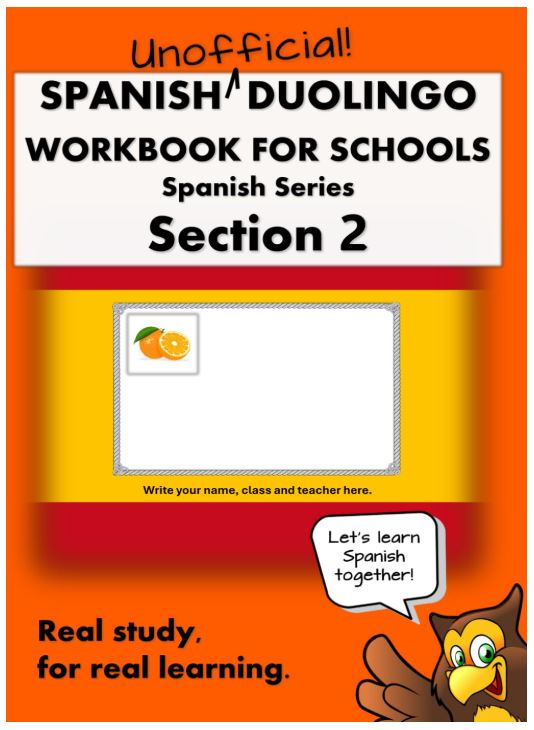
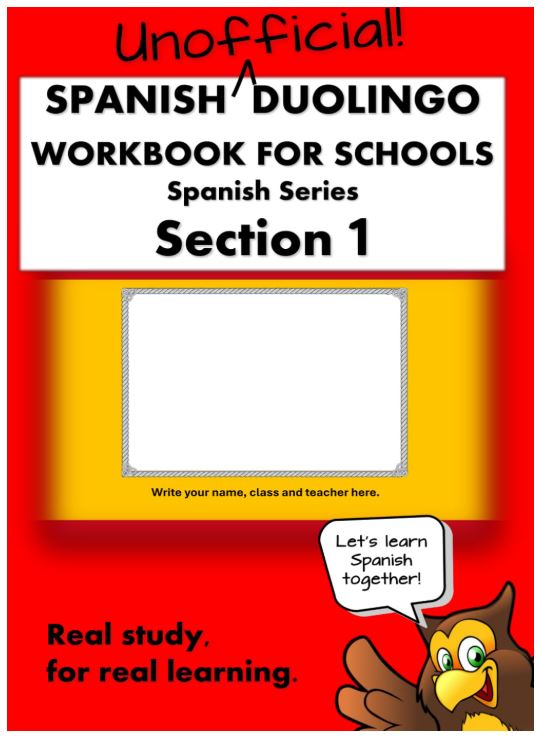
Key features
- 180 photocopiable pages
- Habit tracker
- List of vocabulary items to learn for each unit
- Space to note Duolingo phrases
- A conjugated verb for each unit
- Duolingo inspired questions to answer with the help of AI
- A simple on-theme dialogue for each unit
- Grammar explanations for each unit
- Suggested websites for further study
- Fully backed up with a YouTube lesson for each chapter, presented by the author
- Journal prompts to encourage the Spanish journaling habit
- Teaching notes and ideas
 DuoBookClub.com