Vocab test
- Un hermano – A brother
- Una hermana – A sister
- Un hijo – A son
- Una hija – A daughter
- Un perro – A dog
- Un gato – A cat
- Un abuelo – A grandad
- Una abuela – A grandma
- La madre – The mother
- El padre – The father
Verb of the day
Conjugate the verb TENER (to have) in the present tense.
| Yo | Nosotros |
| Tú | Vosotros |
| Él/ Ella/ Usted | Ellos/ Ellas/ Ustedes |
Questions to answer
1. ¿Tienes un hermano?
2. ¿Tú tienes un perro o un gato?
3. ¿Tú casa es bonita?
4. ¿Tú vives aquí?
5. ¿Tu familia es interesante?
6. ¿Tu familia es grande?
7. ¿Tu abuelo tiene un hermano?
8. ¿Tu madre es inteligente?
A simple dialogue
Use the Spanish phrases to translate the English dialogue. Write it out and perform it.
- Do you have a brother?
- Yes. I have two brothers.
- Do you have a sister?
- Yes, I have one sister.
- Do you live with your parents?
- I live with my mum.
- Do you visit your grandparents?
- I visit my two grandmas.
- Do you have a dog or a cat?
- I have a dog. He is called Benji.
- What is Benji like? He is very big, he is intelligent, he is fast and he is beautiful.
Use these phrases to translate the dialogue.
¿Cómo es Benji?
¿Tienes un hermano?
¿Tienes un perro o un gato?
¿Tienes una hermana?
¿Visitas a tus abuelos?
¿Vives con tus padres?
Es muy grande, es inteligente, es rápido y es hermoso.
Sí, tengo una hermana.
Sí. Tengo dos hermanos.
Tengo un perro. Se llama Benji.
Visito a mis dos abuelas. Vivo con mi mamá.
Choose from a range of voices to read your dialogue here.
Grammar notes
* Read this information, then use it to quiz a friend.
SIBLINGS, PARENTS, CHILDREN
Hermanos is the plural of hermano, brother. It can also refer to both brothers and sisters. You have to guess from the context whether hermanos means brothers or siblings.
The same is true for other words.
- Padres can mean fathers or parents
- Hijos can mean sons or children
- Abuelos can mean grandfathers or grandparents
In Spanish, when referring to a mixed-gender group or a collective noun, the male plural form is typically used. This even includes the words for they, ellos and ellas.
- Use ellos when referring to a group that includes at least one male, regardless of how many females are present.
- Use ellas when referring to a group of females, with no males included.
TÚ AND TU
Tú with an accent is the informal pronoun meaning you.
Tu without an accent is a possessive adjective meaning your.
- Tú eres mi amigo = You are my friend
- Tu libro está en la mesa = Your book is on the table
PRONOUNS
In Spanish, because the verb conjugation indicates the subject, pronouns are often omitted without changing the meaning.
| Yo hablo = I speak | Hablo = I speak | Nosotros somos = We are | Somos = We are |
| Tú comes = You eat | Comes = You eat | Vosotros sois = You are | Sois = You are |
| Él corre = He runs | Corre = He runs | Ellos beben = They drink | Beben = They drink |
| Ella tiene = She has | Tiene = She has | Ellas quieren = They want | Quieren = They want |
| Usted está = You are | Está = You are | Ustedes viven = You live | Viven = You live |
Look up “different words for YOU in Spanish.”
Journal prompts
| Answer the questions, and describe the people/ animals that you mention. Use a translation tool to put your responses into Spanish. Write them out, then check them with your teacher. Interview a friend. | |
| Do you want to have children? | ¿Quieres tener hijos? |
| How many siblings do you have? | ¿Cuántos hermanos tienes? |
| Do you want more siblings? Why? | ¿Quieres más hermanos? ¿Por qué? |
| Do you have a dog? | ¿Tienes un perro? |
| Do you want another dog? Why? | ¿Quieres otro perro? ¿Por qué? |
Buy the workbook in print!
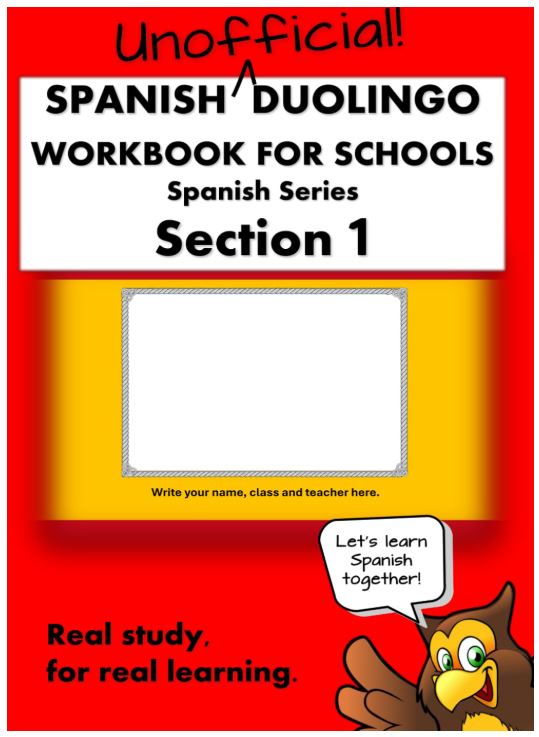
Key features
- Photocopiable habit tracker
- List of vocabulary items to learn for each unit
- Space to note Duolingo phrases
- A conjugated verb for each unit
- Duolingo inspired questions to answer with the help of AI
- A simple on-theme dialogue for each unit
- Grammar explanations for each unit
- Suggested websites for further study
- Fully backed up with a YouTube lesson for each chapter, presented by the author
- Journal prompts to encourage the Spanish journaling habit
- Teaching notes and ideas
 DuoBookClub.com